QUANTUM1NET - mission is to create enabling and enabling technologies
Quantum1Net Mission
The Quantum1Net mission is to
create enabling and enabling technologies. We have designed a very safe
product so you do not have to worry now or in the future about the
security of your data. We introduce an unparalleled level of technical
innovation, combined with user-connected system design to provide
security, ease of use, and ultimate peace of mind.
Quantum Computing
Quantum Computing makes it possible for Quantum bits, called qubits to
store large amounts of information at the same time need less energy to
do so. The result is much better computer capable of running a much more
complicated calculation, and much faster than an ordinary computer.
Ordinary computers work by storing data in a series of bits, holding
either 0 or 1. String bit lengths store information, but at one time
bits can only have one value or other value, so only one calculation.
done at one time. Quantum computing works differently. It is based on
the unique behavior of subatomic particles to be able to exist in more
than one country at the same time.
End of RSA Encryption
Electronic communications have been secured by a method known as RSA,
named for three researchers who developed this method: Ron Rivest, Adi
Shamir, and Leonard Adleman. It takes a large amount of computing power
to produce and then takes into account these numbers, something that is
not possible with ordinary computing techniques.
The difficulty in doing so is illustrated in a 2009 study. Researchers
found that 768 bits (232 digits) spent hundreds of machines and almost
two years to crack, while RSA 1024 bit keys took a thousand times
longer, and that was the RSA key type the smallest one used today.
Safe and least RSA depends on traditional computational constraints
while rapidly expanding technologies and the emergence of quantum
computing soon require a new encryption strategy. Much less resources
and time needed to break even the strongest RSA keys with quantum
computing. Quantum computing empowers first credential threats against
RSA encryption from the start.
Quantum Computing and Code Solving
Prior to Quantum computers would have a positive effect on the
technology industry, their expertise also brought issues of security
issues. RSA depends on the complexity of a large amount of factorization
to store encrypted data. Due to its architecture, quantum computing
becomes a direct solution to this problem.
Because the qubit has the advantage of having a state at the same time
called superposition of circumstances, allowing to do a lot of
calculations, Quantum computer becomes a logical code-breaking
mechanism. Work is underway, and NIST expects a quantum computer capable
of breaking RSA2048 in hours by 2030 to be purchased for a cost of
about a billion dollars.
Quantum Encryption Key
The Quantum Key Encryption Generator is at the core of the Quantum1Net
encryption strategy. To review, generate a multi-digit random number
from which the mathematical property is derived in case of RSA primary
factorization. However there is one major problem, random generators are
used only pseudo-random (so-called PRNGs), so RSA keys are pseudo
random. Tests show that PRNG shows repetitive behavior patterns when
selecting random numbers. This pattern means that with sufficient
results, predictions can be made for the selection of the number in the
future. That way, PRNG is not really random.
Quantum1Net instead relies on Quantum Encryption Key Generator (QEKG).
Due to the nature of the quantum computer itself, tests have shown that
in large samples the number chosen does not follow the pattern so that
no predictive algorithm can be derived.

This graph shows the results of PRNG and QEKG tests on a sample size of
20,000 bits 50,000 times. By using PRNG, after 50,000 tests, it is seen
visually that the data is predictive even after 10,000 or more first
experiments. With QEKG however it is not the case. Look at the bottom of
the graph where the dots are more dispersed. Unlike PRNG graphs, on the
QEKG chart there is no clear pattern to their location.
Quantum1Net Prototype
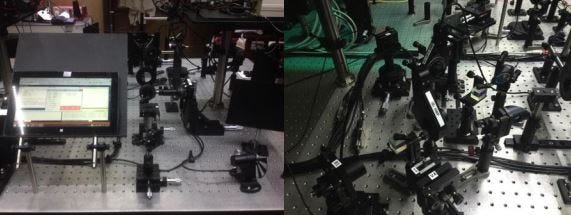
The laboratory prototype of Quantum1Net’s Quantum Random Number
Generator, which has been in development since 2014, is based on a
one-qbit optical device, that uses four photon detectors and
time-to-digital (TDC) converter to generate sets of perfect random
numbers with timestamps. The quantum device consists of an entangled
photons source, and linear optical elements, which sets the quantum
system to the desired state. Two configurations have been developed to
generate sets of 4 and 6 elements respectively. The output of the TDC is
the temporary queue, from which sets of unique random numbers or
encryption keys can be requested, creating a real time, on demand
encryption and decryption system.
Quantum Tokens
Quantum1Net launches two types of tokens: the first Silver Token that
can be converted in February 2018 without quantum key encryption, and
unlimited release quantum keys extracted to Gold Token in July 2018.
Silver token holders can change their ownership at a discount. The full
deployment of Gold Token and Quantum1Net is currently scheduled for
January 2019.
Timeline ICO
Sales Token # 1: silver token
Ethereum based
February 2018
Convert to Gold Token with 20% off
Sales limit of 15 million
Sales Token # 2: Gold Token
July 2018
Bitcoin-based, including QEK
Silver Token investors get priority
Sales limit of 18 million
Sales Token # 3: Gold Token
January 2019
Bitcoin based, QE activated
Silver Silver Investors converting on July 2018 sales may participate at a 5%
Sales Limit 200 million
Quantum1Net Roadmap
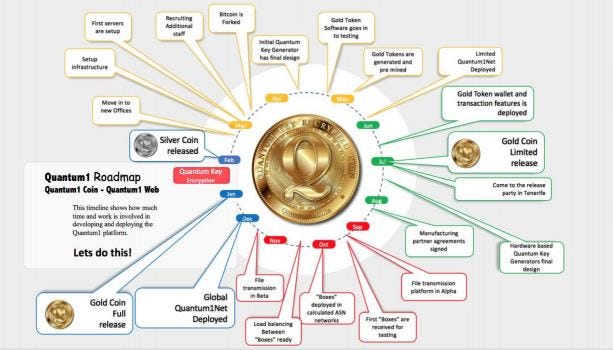
Quantum1Net expects to continue development through the first part of
2018. The hiring of additional developers in March 2018 should allow us
to finalize development of the initial QEKG the following month,
supporting a limited Quantum1Net deployment in May. The final design for
the hardware-based Quantum Key Generation should be complete in July,
followed by the signing of manufacturing partners by the end of Summer
2018. Fall of 2018 is when we fully expect to start racing towards a
global Quantum1Net launch in January of 2019. We expect the ‘alpha’
version of the Quantum1Net file transmission platform initially during
September, and a beta version in November 2018. The release version is
likely to be completed the following month, which paves the way for the
global Quantum1Net release targeted for Q1 2019.
Further information Detail Link :
Website: https: //quantum1net.com/
WhitePaper: https: //quantum1net.com/Q1N%20white%20paper.pdf
Telegram: https://t.me/Quantum1Net
Facebook: https://www.facebook.com/quantum1net
Twitter: https://twitter.com/quantum1net
Profile : Endanglex
https://bitcointalk.org/index.php?action=profile;u=1743568
My Addres : 0x77FA8d2cC97975349F63E0ed1d4372B9865702A9
https://bitcointalk.org/index.php?action=profile;u=1743568
My Addres : 0x77FA8d2cC97975349F63E0ed1d4372B9865702A9


Komentar
Posting Komentar